Thursday, May 14, 2009

Anybody have an iron?

The doubleweave baby blanket I was weaving for my neighbors Chad and Sarah's baby Bella was all done this afternoon! With doubleweave, you can (among other perks) weave a project twice the width of your reed. It's like magic. I never go all the way down the reed when warping, just get kinda close, so my doublewidth projects can be about 22 inches wide versus the usual 11 or so. The rented table loom I've had since last July (I've put off returning it because I probably owe $150 in rental fees at this point) has 4 heddles, which means I can only do plainweave when I'm doubleweaving, the under-and-over "regular" weave that some people might remember from grade school Weave-It days. So yeah, not super interesting, but by playing with color you can create nice plaids, which is what tried to do while working on this blanket.
I started warping back in, oh, January, when I didn't know the sex of the baby. Plus, hey! green is pretty. Since this project hasn't been super-inspiring, I got distracted and didn't finish till now, a week after Bella was born. :) I was so excited about finishing that I cut it off the loom, even though there was still a lot of warp left, though it can be retied for other projects.

Then I saw it. The dreaded crease. This happens sometimes, especially to novice weavers like myself, when the left (doublewidth) selvage is too tight and the threads pull together. When you warp for doubleweave, you have to double your EPI (ends per inch), and so the reed is just *loaded* with threads. I tried to counteract the crease this time by spreading out the two warp threads furthest to the left in the reed, hoping that even if my selvage was tight, the added room would aid in the threads being properly spaced out in the finished blanket.

No go. This is what happened:

Now the thing to do is to patiently pick out one or two vertical (warp) threads from the blanket, giving the remaining threads room to spread out. Not too much of a hassle, but darn it! I'd hoped that I wouldn't have to deal with this crease thing again. Maybe spacing out 4 or more far left warp threads would have been the solution...

Wednesday, May 6, 2009

My Torture Devices: a Love Story

My ridiculously pointy combs have arrived from Canada! Actually, they arrived several weeks ago, but I got neglectful of the blog. Anyway, I decided to bite the bullet at the beginning of March and ordered a set of Alvin Ramer Super Mini Combs in cherry wood. I'd been debating for a long time about what my next fiber tool would be. A swift would be great, but Josh doesn't seem to mind holding out his hands for me while I use the ball winder. A drum carder would make me a happy, happy girl, but my guild has a Patrick Green Deb's Delicate Deluxe carder that I've been fortunate enough to rent on occassion, and that has suited pretty well. Actually, what the heck am I talking about, I fell in love with it. It's only rentable by the month, though, so when my month's up, I have to return it and put my name back on the waiting list. I imagine that I may break down and buy one at Estes Park Wool Market in June, since Susan's Fiber Shop has a booth, and she usually has a couple PG carders waiting in the wings for some weak person like me to come along. :)

But back to the combs! What can I say? They are truly magnificent. Once I got over the guilt of not ordering LaniCombs (they're local, but pricey), I reveled in all the features of these lovely Ramer Super Minis. First of all, they come with a carding station, which is a superduper plus. Also, they're actually weildable, unlike some regular combs. My arms/wrists don't get as tired with these as they did using the larger combs. They come two-pitch standard, which does the job with most fibers. Folks, I'm really, really happy with the job they do. So without further ado, the pictures...

Here is the set-up, with the combing station clamped to the picnic table with C-clamps. The picnic table is actually a bit low for combing, I've learned...larger C-clamps are in order so the station can be secured to a thicker table. The first comb is charged with a wonderful cold-soaked Corriedale/Merino/Rambouillet fleece I bought online and scoured. The wool is from Wooly Wool of the West , and it is to die for...barely any veggie matter, and so soft and lovely!
Next we have the action shot. The charged comb is turned sideways for minimal chance of impalement and the active comb is sliding through like buttah. I don't usually comb with my left hand, but I REALLY can't take pics left-handed, so there ya go.
Here's a pic of the fiber dizzing off through the (included) seashell diz. Pillowcase of happy fluff and water bottle (for spritzing the wool when it gets too static-y in this dry Colorado environment) also pictured.

Happy nests of fiber ready to spin!
What those happy nests became!


Monday, April 13, 2009

Yarn Everyday

I joined the Yarn Everyday group over at Ravelry! The basic premise is that we spin at least a little every day in April, and must take a daily picture. That last caveat is the kicker for me...spinning everyday is a given, but photo-taking...well, let's just say there are about 20 skeins of yarn waiting for me to take their pictures for my shop. Which is why my shop is so rarely updated. I'm hoping that with the longer days I'll be able to get outside and take pics more often, since the inside of my apartment is as dark as a cave.

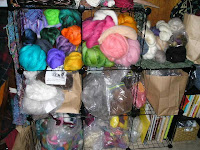
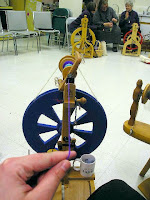
My pics so far mostly consist of spinning, with a little stash reorganization mixed in for good measure. The pic with my wheel shows me spinning at my monthly Spin-in, with other spinners and neat wheels in the background. Anyway, without further ado, here are the first week's worth of yarn everyday...

Wednesday, February 18, 2009

Characteristics of Fibery Animals

I was on Craftster yesterday, answering a query regarding the qualities of different animal fibers. I think my brain is programmed for this kind of trivia...I love answering questions like that! :) Anyway, I thought I'd repost on my blog. The whole section up until Huacaya Alpaca addresses different sheep breeds.

Merino - the finest and softest of the sheep breeds. Bred in Spain, where it was illegal for a while to export them. Short staple length, high crimp, fast to felt. The crimp of the merino also makes it one of the most elastic of the sheep breeds.

Rambouillet - a French breed decended from a herd of merinos either purchased by or gifted to King Louis XVI by the king of Spain. Like merino, rambouillet wool is very fine and soft.

Corriedale - a medium-fine wool, suitable for beginning spinners because its staple length is not as short as merino. (Other medium-wool breeds: Finn, Polworth, among others)

Cormo - corriedale/merino cross, with qualities of both breeds.

BFL (Bluefaced Leicester) - English longwool breed with a surprisingly soft handle. Has a slight sheen/luster, as is typical of many longer-stapled wools.

Cotswold - English breed with a long staple and low crimp, which gives the wool a wavy/curly appearance.

Lincoln - English breed with long-stapled, lustrous, hard-wearing wool. (other long-wooled breeds: Romney, Border Leicester, among others)

Icelandic - double-coated sheep. Outer coat is good for rugs and is hard-wearing, inner coat is next-to-skin soft.

Jacob - multihorned, primitive breed of sheep (seriously, they are amazing-looking) with spotted black/white fleece. Medium-fine wool with some kemp (hair-like fibers) throughout (varies - depends on the individual animal).

CVM (California Variegated Mutant) - decended from Romeldale sheep, with a fleece that varies from white to brown to black.

Course wool breeds include Scottish Blackface, Cheviot, Black Welsh Mountain, and Karakul. Course wool is great for making rugs and very-hard-wearing outer garments.

Huacaya Alpaca - New World camelid bred for its fleece by the Inca. Baby alpaca is free of guard hairs, which increase in number as the animal ages. Alpaca is seven times stronger than wool and three times warmer. Most alpaca fiber is not as crimpy as wool, so it doesn't have the "memory" and elasticity of wool and tends to drape.

Suri Alpaca - type of alpaca with a silky, lustrous coat.

Llama - New World camelid bred by the Inca as a fiber and pack animal. Larger than the alpaca. Llama fleece is not quite as fine as alpaca, and is likely to have more guard hairs.

Vicuna - New World camelid. Its fleece is extremely fine and was once reserved for Inca royalty. It was very difficult to domesticate, however, which is why it was nearly hunted to extinction for its fiber. Smallest of the New World camelids and endangered. I believe vicuna fiber is still illegal to import, though their numbers have recently increased and there are a few being raised in the States.

Guanaco - largest of the New World camelids. Fleece comparable to the llama. Difficult to domesticate.

Camel - sheds its downy undercoat periodically. Camel down is very soft and fine, suitable for next-to-skin items. Camel hair (the outer coat) is often used in the Middle East for rugs, rope, and was historically woven into a coarse fabric used for tents. Camel down fiber has been compared to cashmere in its softness.

Cashmere goat - not actually a breed of goat, but a hair type bred in goats. The cashmere that we know is actually the undercoat...the long guard hairs must be removed. The undercoat is fine, very soft, and strong.

Angora goat - produces mohair, which is a long, lustrous, strong fiber. Mohair is very lightweight and does not wrinkle or crush easily. Teased apart, mohair is cloudlike and soft.

Angora bunny - Angora bunny fur is very soft, and finished items have a distinct halo. It is very lightweight and is seven times warmer than wool. It does not have the elasticity of wool, however, so produces a drapey fabric.

Bison, Musk Ox (Qiviut), and Yak - like the camel, the commonly spun fiber comes from the downy undercoats of these animals. Extremely fine luxury fiber.